These easy-to-follow free workouts for men over 40 can help you lose weight, get fit, and grow stronger at your own pace.
Choose between a weight loss program or a strength and toning program depending on your goal. Each warm-up, exercise, and stretch has step-by-step instructions to help you perform the exercise safely.
When you purchase through links on our site, we may earn an affiliate commission. Here’s how it works.
Table Contents
Can a man get in shape at 40?
YES – You can improve your fitness at any age!
It’s perfectly possible for any guy to get in shape after the age of 40…even you!
It doesn’t matter if you haven’t exercised in years and years. It’s never too late for you to:
- Lose weight
- Get fit
- Build muscle mass
- Boost your testosterone levels
- Sleep better
- Have more energy
- Be a better father and husband
- Be happier
Even if the last time you exercised was in high school gym class, starting an exercise routine today and consistently working out can be a significant turning point to getting in shape, improving your health, and feeling great!
Workouts for men over 40
What do you want to change about your body?
Are you currently overweight, or do you just want to tone up?
Check out your current BMI
If it’s higher than 25, then sorry buddy.. you’re too fat!
- You need to lose weight.
- It’s time to get rid of the belly and the man-boobs.
- Choose the Weight Loss workout
If you BMI is less than 25, then choose the Strength & Toning workout.
Use the button below to chose the workout schedule based on your goal:
Weight loss workout
How to lose weight
The weight loss industry likes to make weight loss sound very complex, but it ultimately boils down to basic physics.
Weight Lost = Food In – Energy Out
That means you need to create a calorie deficit.
You can workout all day everyday, but if you eat more you won’t ever lose any weight.
Follow these three steps
- Use the Weight Loss Calculator to find out what your daily calorie in-take should be.
- Download a calorie tracking app like MyFitnessPal – Use it to record everything you eat and stay broadly within your daily calorie goal.
- Follow the workout schedule below.
What results to expect
The first week or two you’ll have DOMS (Delayed Onset Muscle Soreness).
Basically, some of your muscles are going to hurt at the start – but that hurt is just your muscles waking up and getting stronger.
While you have DOMS your body will hold onto more water to help heal the muscles. This is normal, but it will mean your weight may not go down as you expect – don’t worry.
Stay with it and use other things to measure success, things like:
- Days you managed to stay within the calorie target
- Sleeping better
- Feeling like you have more energy
- Number of pushups you were able to do
- Tape measurement of your chest or stomach
- Feeling of a t-shirt that was just a bit too tight and now feels more comfortable
By the end of two weeks, you should start to notice that you’re already starting to feel a bit fitter and stronger.
After the first two weeks, the DOMS will pass. As this happens, you’ll start to see results on the scales. If you’re in a calorie deficit of 500-1,000 per day, you can expect to lose about 1-2 lbs per week. Thereafter, your weight loss will continue. You’ll hit days in a row where it seems like you’re not making any progress on the scales, and then all of a sudden you’ll notice it drop again. You’ll continue to get stronger. Stick with it.
Workout schedule
The schedule is spread over 5 days with rest days in between.
Each workout should take around an hour, including a warm-up, a workout then a stretching cool-down.
3 days are focused on cardio:
- Use a walk / run combination.
- Get fitter and gradually able to run more.
- Improve your ability to burn more calories in the same workout time.
2 days are focused on strength training:
- Build your muscles so they’re stronger and have more tone.
- When you strengthen your abs, they act like a corset, compressing and pulling in your stomach.
Feel free to adjust the days but:
- Don’t do 2 days cardio back to back.
- Don’t do 2 days of strength back to back.
- Don’t do any more than 3 days without a rest day.
Follow the links to jump down to the details of each session.
| Monday | Warm up | Cardio workout | Stretch |
| Tuesday | Warm up | Strength workout | Stretch |
| Wednesday | Rest | ||
| Thursday | Warm up | Cardio workout | Stretch |
| Friday | Warm up | Strength workout | Stretch |
| Saturday | Warm up | Cardio workout | Stretch |
| Sunday | Rest | ||
If one day you’re pushed for time and need to cut something short that’s fine…..but reduce the Cardio or Strength workout.
Don’t skip the warm-up or post workout stretches – these are critical when you’re in your 40s.
Pushed for time?
Cardio workouts
Your cardio sessions are going to focus on building your fitness, by building your ability to run.
Running is one of the most time efficient ways of burning calories.
A 200lb guy doing a slow run for 50 minutes burns over 700 calories.
Don’t worry, you don’t need to be able to run for 50 minutes to get started.
You can start with walking. If walking is as much as you can do to start, then your cardio sessions will be walking, but over the course of the plan you’ll gradually start to include a bit of running.
Head over the beginner’s running plan. Enter how many minutes you can currently run today and it will give you a running plan based on your current level.
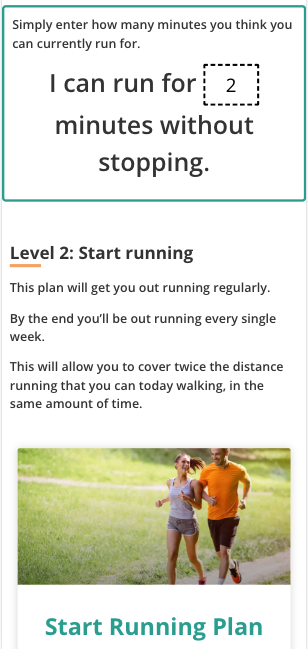
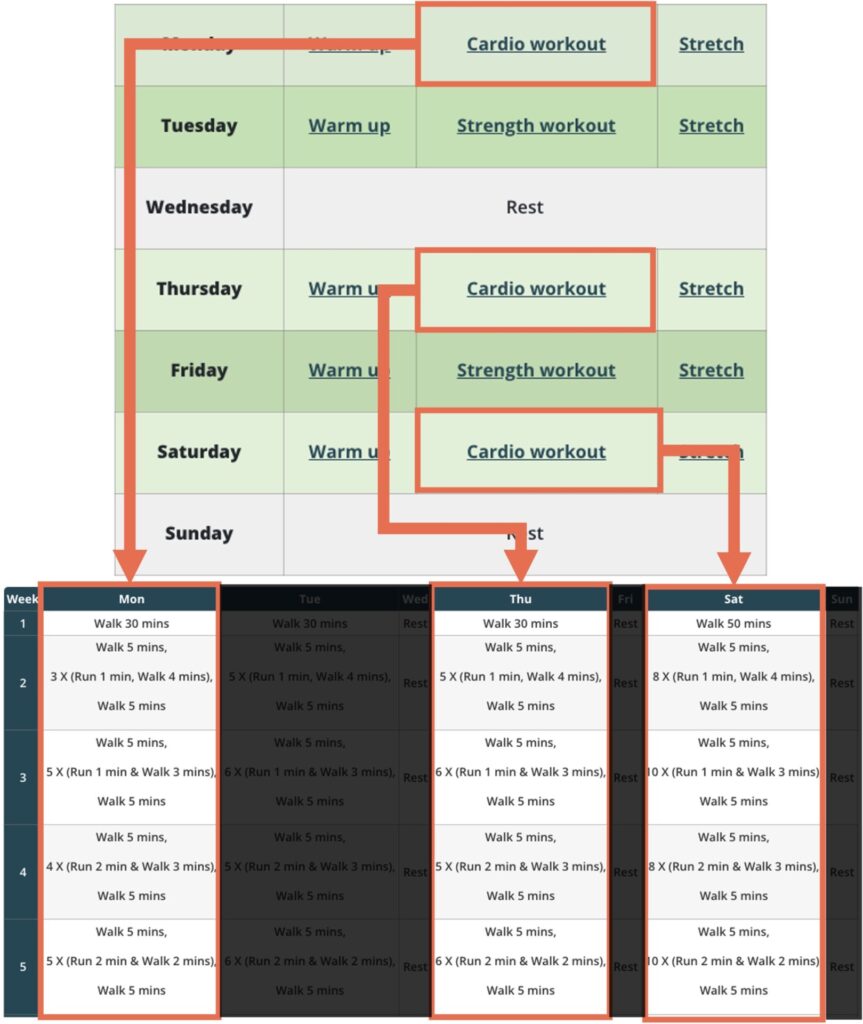
The running plan will show 4 days of running per week, but your workout schedule only calls for 3.
Do the running activity that aligns with the same day from your workout schedule.
- Start every cardio session with a warm-up of dynamic stretches.
- Do your cardio workout.
- Finish every session with the cool-down stretches
Remember
Strength and toning workout schedule
How to get stronger and tone up
Building and maintaining strength is important for all ages. However, in your 40s, it becomes even more vital for your health. It preserves muscle mass, promotes bone density, boosts your metabolism and can help with your joint health.
Put simply:
When you’re over 40 – you need to be regularly lifting heavy stuff.
You can build all the strength you need, lifting your own body weight.
This routine uses a combination of pushing and pulling to build strength in your:
- Arms and shoulders
- Back and core
- Glutes and legs
All you need is a few simple pieces of equipment and a few square yards of space to workout out in.
What results to expect
The first week or two you’ll probably have DOMS (Delayed Onset Muscle Soreness) .
Basically some of your muscles are going to hurt at the start – but that hurt is just your muscles waking up and getting stronger. These will pass after the first couple of weeks.
By the end of two weeks you should start to notice that you’re already getting stronger.
As you continue week-after-week you’ll find you can do more of the exercises with less support.
You’ll start to notice results in your body after about 4 weeks.
Other people will start to notice it after 8 weeks.
Workout schedule
The schedule is spread over 3 days with rest days in between.
Each workout has 9 exercises, arranged into 4 groups. Each grouping combines 3 sets of exercises working on different muscle areas. This allows you to rest muscles between sets while making the best use of your time.
For example, in one group you’ll do a set of reps focused on your arms then a set focused on your legs, and then repeat 3 times.
The full workout will take around an hour, including warm-up, workout, and then the stretching cool-down.
You can adjust the days you use for workouts but, don’t do 2 days strength back-to-back.
Follow the links to jump down to the details of each session.
| Monday | Warm up | Strength workout | Stretch |
| Tuesday | Rest | ||
| Wednesday | Warm up | Strength workout | Stretch |
| Thursday | Rest | ||
| Friday | Warm up | Strength workout | Stretch |
| Saturday | Rest | ||
| Sunday | Rest | ||
If one day you’re pushed for time and need to cut something, drop a set from each exercise or if you really have to, a full group of exericses.
Don’t skip the warm-up or post workout stretches – These are critical when you’re in your 40s.
Pushed for time?
Warm up: Dynamic stretches for upper body, core and legs
The purpose of the warm-up is to prepare your muscles for the demands you’re about to put on them.
Now you’re in your 40s, you’re even more likely to strain or tear a muscle if you don’t warm up properly.
Dynamic Stretching moves your joints and muscles through their full range of motion slower than you would in full exercise. It gradually increases your heart rate, while gently stretching and increasing the blood flow to your muscles.
Benefits of dynamic stretching
- Improves range of motion: Dynamic stretching can improve your flexibility which makes it easier to perform your workouts.
- Reduces muscle soreness: If you feel stiff from a previous workout or perhaps from sitting hunched over a laptop all day, dynamic stretching can help reduce soreness.
- Improves your balance and coordination: Dynamic stretching can help to improve your balance and coordination, which reduces your risk of injury.
- Enhances performance: Dynamic stretching can help to improve your performance by enhancing your power, speed, and agility.
Aim to spend 5 to 10 minutes before any workout doing the following dynamic stretching routine.
Neck warm-ups
Repeat these movements 5 times each slowly:
- Tilt your head forward so your chin touches your chest
- Lift your head backward to look up above you.
- Rotate your head so your chin touches your shoulder, left then right.
- Roll you head to the side (ear towards shoulder), left then right.
https://www.youtube.com/watch?v=dC-boFTgNwQ
Arm rotations at the shoulders
Repeat this 10 times forward then 10 times backwards:
Put your arms out the side, then rotate them in circles, with the circles gradually getting larger until your arms brush your ears.
https://www.youtube.com/watch?v=3STTSi_jdHk
Trunk rotations
Repeat 5 times:
Hold your hands in front of you, plant your feet securely on the ground, and rotate side to side.
https://www.youtube.com/watch?v=W1dK4tF7_5E
Leg swings – forwards and back
Stand next to a wall or table to use for balance.
Repeat 10 times on each leg:
- Swing your leg forward and back, starting low and increasing in height, so counts 9 and 10 will be as high as possible.
https://www.youtube.com/watch?v=XiNe_pjaLOc
Leg swings – side to side
Stand next to a wall or table for balance.
Repeat 10 times on each leg:
- Swing your leg left to right, starting low and gradually getting higher. By count 9 and 10, it’s as high as possible.
https://www.youtube.com/watch?v=-666xc6HCD0
Ankle rotations
Ankle rotations are very important before a walk or run. Hold onto a wall for balance.
Repeat 5 times:
- Rotate your ankles clockwise, then anti-clockwise.
https://www.youtube.com/watch?v=zwZBcMuNN6c
Jogging on the spot
Repeat for 2 minutes:
- Jog on the spot, slowly increasing speed so the last 15 seconds feel like a sprint.
If you’re not able to jog or can’t manage the full 2 minutes then march on the spot. In the last 15 seconds focus on lifting your knees as high as possible.
Jumping jacks
Repeat for 20 jumping jacks:
- Start with your legs together and arms by your side.
- Jump so your legs are now shoulder wide, while at the same time raising your arms sideways so to clap above your head
- Jump back so legs are together and arms are by your side.
If you’re unable to do jumping jacks, or to complete the full set of 20, then repeat the same motion with a step rather than a jump.
https://www.youtube.com/watch?v=D47Q8l95XhM
Equipment
For your strength workouts, you’re going to need a clear space to workout in.
A garage is ideal for a workout location. You can get away from the family for an hour with time to focus on your workout without interruption. You don’t need the whole garage, but allocate an area that you keep for your workouts.
You’re going to want to get these 4 pieces of equipment:
Wall mounted pull-up bar
This is critical to many strength workouts. You’ll use the pull-up bar not only for pull-ups but also doing strength work on rings and resistance bands.
This wall mounted pull-up bar is easy to setup and solid.
Ideally mount it so you can just reach the bar on your tip-toes.
[lasso ref=”amzn-yes4all-heavy-duty-wall-mounted-pull-up-bar-chin-up-bar-pull-up-bar-wall-mount30-lbs-support-up-to-500-lbs-black” id=”23476″ link_id=”21563″]
Resistance bands
Resistance bands will help you build up strength gradually, by supporting your weight in exercises like pull-ups or dips. You can also use them to add resistance, such as to make an exercise more difficult.
This pack is a great pick as it has a wide range of thicknesses. As you progress in your strength you’ll want to mix and match the bands and you need them less and less for support or more and more for extra resistance.
[lasso ref=”amzn-thinefit-pull-up-assistance-bands-resistance-band-pull-up-bands-workout-band-resistance-band-set-of-6-with-door-anchor-exercise-band-for-working-out-muscle-training-physical-therapy-shape-body” id=”23477″ link_id=”21564″]
Rings and straps
Hanging rings from your pull-up bar provides you with options for doing multiple exercises at varying different heights, such as rows, dips, abs rollouts.
One of the challenging things with rings is repositioning them both at the same height – this pack makes that very easy with the numbered straps making identical positioning simple.
[lasso ref=”amzn-pacearth-gymnastics-rings-wooden-olympic-rings-1500-1000lbs-with-adjustable-cam-buckle-14-76ft-long-straps-with-scale-non-slip-gym-rings-for-home-gym-full-body-workout” id=”23475″ link_id=”21565″]
Interlocking mats
You’re going to spend a lot of your workout time on, or moving around the floor. Interlocking mats provide a simple support and cushioning to your feet and body instead of working out on a hard floor. They are easy to lay and claim your workout space.
You can buy these in multiple sized packs. At a minimum, you need 6 mats to cover an area beneath the pull-up bar, if you’ve got the space for 36 or 48 this gives you a great mini gym layout.
[lasso ref=”amzn-prosourcefit-puzzle-exercise-mat-%c2%bd-in-eva-interlocking-foam-floor-tiles-for-home-gym-mat-for-home-workout-equipment-floor-padding-for-kids-black-24-in-x-24-in-x-%c2%bd-in-48-sq-ft-12-tile” id=”23479″ link_id=”21566″]
Strength and toning workout for men over 40
The strength workout consists of 4 groups of exercises.
Each group contains either 2 or 3 exercises, which are paired together. The pairing allows you to alternate between sets of exercises, to allow you some muscle recovery, while making the most effective use of your time.
Don’t forget to warm up properly before heading into a strength workout.
Repeat each group 3 times before moving onto the next group.
Then ensure you do a cool-down stretch at the end
- Group 1
- Band-assisted pull-ups
- Bodyweight squats
- Group 2
- Band-assisted dips
- Romanian deadlift
- Group 3
- Incline ring rows
- Knee pushups
- Group 4
- Planks
- Banded Pallof press
- Arch leg raises
Group 1
Band-assisted pull-ups
The back is the main muscle group worked by doing pull-ups. However, they will also work your arms (biceps, triceps), shoulders, back, core, and more. If you can’t yet do a pull-up don’t worry, there are plenty of ways to progress. One of the best ways is to do assisted pull-ups with resistance bands.
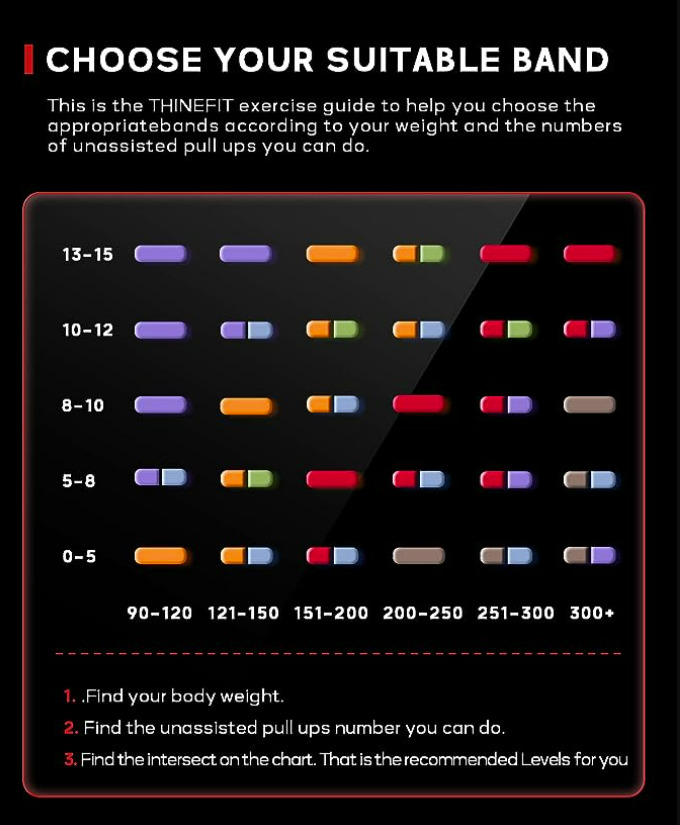
The THINEFIT Pull-Up Assistance Bands are color-coded according to the resistance of the bands. Use your body weight and the number of unassisted pull-ups you can do, to find the most suitable band.
Reps
Start with 5 reps, and aim to progress by 1 rep each week.
To aid your progression every now and again do some negatives – jump up, grab the bar, and lower yourself down to the ground slowly without the use of a band. For more on this, read How to do more pull-ups.
How to do a band-assisted pull-up
https://www.youtube.com/watch?v=_JSKauLJ5No
- Loop the band securely over the pull-up bar
- Put one knee into the band and make sure the band is securely over your leg.
- Pull yourself up using the band to assist you
You can use resistance bands for most types of pull-ups. For more details on how to do a pull-up, check out this article on the Men’s Health website.
Bodyweight squats
Squats are a functional movement and one of the key bodyweight exercises you can do, particularly as you get older. In fact, according to Everyday Health, for one particular study, researchers found that the ability to sit and get up off the floor can potentially be used to predict your chance of dying early.
Squats activate your glutes, quads, hamstrings, hip flexors, and calves.
Reps
Start with 5 reps, and aim to progress by 1 rep each week up to 8 reps.
How to do a bodyweight squat
https://www.youtube.com/watch?v=YaXPRqUwItQ
- Stand with your feet shoulder-width apart and your toes pointing forward. Make sure your knees are over the second and third toes.
- Hinge at the hips and lower your butt to the floor as if you are about to sit in a chair. Keep your heels and your big toes on the floor and make sure your knees move over your toes. (Don’t move your knees in or out).
- Lower as far down as you can without losing form.
- Push into the floor with your feet to push yourself back up and away from the floor while moving your hips forward into the starting position.
If it’s challenging to do a squat, hold onto something to give you support and help you keep your balance. For example, you can hold onto the rings or perhaps use the bands for balance.
Group 2
Band-assisted dips
Dips work the chest, triceps, shoulders, and abs. It’s an effective way to grow muscle (hypertrophy) and strengthen your chest and triceps.
Ring dips are a bit more challenging than bench dips but with the help of a band, you’ll soon get the hang of it.
Reps
Start with 5 reps, and aim to progress by 1 rep each week up to 8 reps.
How to do a band-assisted dip
- Set the rings so that they are elbow height and even.
- Loop one end of the band through each ring then hold with your hand in a neutral grip. (If you find this uncomfortable, loop the band over the bar like assisted pull-ups.)
- Put one knee on the band to support your body.
- Push yourself up off the rings with your one leg straight.
- While staying upright, lower yourself between the rings as low as possible then push up so your arms are fully locked.
If you can’t manage any reps with the band, then get rid of the band and instead put your heels on the floor in front of you.
Try to do as much of the movement as possible without the use of your legs, but then when necessary give a little push with your legs. Work up till you can do 8 of these, then get your feet off the ground again.
https://www.youtube.com/watch?v=sFRNSFQwppY
Romanian deadlift
The Romanian deadlift is a barbell lift that develops strength in the back, glutes, hamstrings, and adductors. If performed properly, it works the core and your lower body in one exercise. According to the American Council on Exercise, one benefit of the Romanian deadlift is that it teaches you how to lift from the hips and not your lower back which can protect your back.
The key is to hinge at the hips and keep the spine straight. If you don’t have a barbell, grab a spare broom or any pole. The hip hinge is the main movement that you want to master.
Reps
Start with 5 reps, and aim to progress by 1 rep each week.
How to do a Romanian deadlift
- Hold a bar palms-down with your hands about shoulder-width apart, your feet hip-width apart and your knees slightly bent.
- Rest the bar or broomstick along the front of the thighs.
- Lift the chest, tuck your chin, and keep a long spine while you hinge at the hips while lowering the barbell or broomstick until you feel tension in the back of your thighs. Keep the chin tucked to protect your cervical spine.
- Push both heels into the floor, squeeze the glutes, and press the hips forward. Pull back to return to standing. Remember to keep your spine elongated.
https://www.youtube.com/watch?v=mZxxJEncsyw
Group 3
Incline ring rows
Incline ring rows target the upper back muscles, shoulders, and arms. It will also challenge your core and stability.
As you lower the rings, the more horizontal your body will be and the more weight you’ll lift.
Reps
Start with 5 reps with the rings at chest height with your body at roughly 45 degrees. Aim to progress by 1 rep each week.
How to do incline ring rows
- Grab the rings with both hands.
- Walk your feet forward until you are at a 45-degree angle to the ground.
- Extend your arms and lock out your elbows.
- Squeeze your shoulder blades together, keep your elbows at your sides, and pull your hands towards your armpits until the rings touch your chest.
- Slowly lower yourself back down until your arms are locked out.
To progress in ring rows, lower the height of the rings or walk your feet out further. As you go past 45 degrees you’ll want to wedge your feet against the wall to prevent them from slipping back.
https://www.youtube.com/watch?v=B90sF7dbP04
Knee pushups
When it comes to bodyweight workouts, pushups are one of the most common exercises. However, not everyone has the strength to smash out a full pushup from the get-go.
This is where knee pushups come in. Knee pushups can help you develop proper form, strength, and endurance so that you can progress to a full pushup.
Reps
Start with 5 reps and aim to progress by 1 rep each week until you can do 8 reps.
How to do knee pushups
- Kneel on the floor or mat and bring your feet together behind you.
- Bend forward and walk your hands forward until there is no bend in the hips.
- Place your hands at shoulder-width with the fingers facing forwards.
- Brace your core by pulling in your gut and tightening the muscles around your spine.
- Keeping your head in line with your spine, slowly lower yourself toward the floor until your chest or chin touches the mat.
- Make sure that you keep your torso rigid and you don’t sag or arch the spine.
- Press up through your arms while keeping your core tight and head aligned until the arms are fully extended at the elbows.
https://www.youtube.com/watch?v=8XQ-okb5NWE
If your wrists are giving you trouble, grip the handles of some dumbbells rather than placing your hands on the floor.
https://www.youtube.com/watch?v=VrSGEXrwZAc
Group 4
Plank
The plank is a core exercise that strengthens the core muscles also known as your trunk. According to the Cleveland Clinic, a strong core is essential for protecting your back and preventing exercise-related injuries. The plank is called a “plank” because you hold your body in a straight line like a plank of wood.
Like pushups, if you can’t manage a full-body plank, start with your knees on the ground and then progress.
Reps
Start with 10-second reps. Progress by 5 seconds each week up to 30 seconds.
How to do a plank
If you feel any shoulder or lower back pain, your form might need to be adjusted.
If you can’t manage a full-body plank, you can lower your knees in the same position as the knee pushups.
If your wrists hurt rather do doing a high-plank, convert to a lower plan, where you have the same position but rest on your forearms instead of palms.
https://www.youtube.com/watch?v=1YfVEMsovOo
Banded Pallof press
The banded Pallof press is another core exercise that challenges your body to resist being pulled or rotated to one side by the band. It strengthens your abs, core, and back and contributes to a healthy, stronger spine.
Reps
Start with 8 reps, and aim to progress by 1 rep each week to 12
How to do a banded Pallof press
- Anchor the band at chest height to an object.
- With your left side towards the band and anchor point, pick up the band with both hands interlaced together.
- Step sideways until the band is tight and trying to twist you towards the anchor point.
- Place your feet shoulder-width apart and bend your knees slightly. Keep your core tight to prevent yourself from twisting left.
- Brace your core and press your arms in front of you until they are straight. Pause and then bring your hands back towards your chest.
- Complete the reps and then repeat on the right-hand side.
If you’re finding it too challenging, move your feet wider apart to give yourself a more stable base.
https://www.youtube.com/watch?v=suXbr509tFQ
Arch leg raises
Arch leg raises and the progression to the arch body hold works all the muscles along the backside of your body (the posterior chain) such as the lower back, glutes (butt), hamstrings, and calf muscles. It involves lying on your stomach on the floor and lifting your legs and arms simultaneously to form an arch.
When done properly, it also activates your upper back and shoulder muscles. It strengthens the core which can help reduce back pain and the risk of lower back injury.
Reps
Start with 8 reps and aim to increase by 1 rep per week to 12.
How to do arch leg raises
This video by Kit Laughlin gives specific cues depending on your level. We suggest starting with the first part of the video to activate the glutes and legs and master that before progressing.
https://www.youtube.com/watch?v=OgyqYuh41Mw
- Lie on your stomach on the floor with your forehead propped on your hands.
- Use your quads to press the legs straight and point your toes.
- Squeeze the legs together and imagine you’re lengthening the body.
- Squeeze the glutes – try to activate the entire part of the glute muscle.
- Tuck in your tail (posterior pelvic tilt) so that your lower abs are lifted off the floor.
- Press your legs away from your body (imagine someone is pulling your legs out of your hip joints).
- Float your legs up and off the floor.
Once you’ve progressed to lifting the legs off the floor and are feeling stronger, follow the rest of the cues for a full arch body hold.
Cool down: Static stretching routine
The importance of stretching in your 40’s can not be overstated!
Do not skip the stretch!
After your workout, your muscles will be contracted and tight.
You probably won’t notice this, but it will slightly affect the way you move. This ends up throwing your whole body out from it’s natural movement, gradually this will become more pronounced over time.
Having tight and shortened muscles is one of the most common causes of injuries.
Static stretches help to elongate the muscles. This gets muscles back to their normal length again as well as increases blood flow. The increased blow flow helps to prevent DOMS.
Hold each stretch while breathing slowly and deeply and try to relax into the stretch as much as possible.
If the muscle starts to shake during a stretch, relax the stretch a bit until the shaking stops.
Neck stretches
Side neck stretch
- Stand with your hands clasped behind your back.
- Look forward while keeping your head up.
- Slowly move your ear towards your shoulder.
- Hold for 20 seconds and repeat on the other side.
- Keep your shoulders down and don’t lift them up when tilting your head to the side.
Neck rotation
- Stand with your hands clasped behind your back.
- Look forward while keeping your head up.
- Slowly rotate your chin towards your shoulder.
- Hold for 20 seconds and repeat on the other side.
- Keep your head up and don’t allow your chin to drop to your shoulders.
Neck flexion
- Stand upright with your head up and your hands by your side.
- Let your chin fall forward towards your chest.
- Hold for 20 seconds.
- Don’t force your head down. Relax and allow the weight of your head to do the stretching for you.
Neck extension
- Stand upright with your head up, your shoulders relaxed, and your hands by your side.
- Look upwards as if trying to point up with your chin.
- Hold for 20 seconds.
- Keep your mouth closed and your teeth together.
Neck stretch routine for neck pain
Shoulder stretches
Posterior shoulder stretch
- Stand upright with your head facing forward
- Place one arm across the front of the body so that it’s parallel to the ground
- Use your other arm to pull your elbow towards the opposite shoulder.
- Hold for 20 seconds and repeat on the other side.
https://www.youtube.com/watch?v=KNfqxl7jkiU
Rotator cuff stretch
- Place your hand behind your back and reach up between your shoulder blades.
- Hold for 20 seconds and repeat on the other side.
Front shoulder stretch
- Clasp your hands behind your back.
- Slowly lift your hands upwards keeping your arms straight.
- Hold for 20 seconds.
Tricep stretch
- Stand with your hand behind your neck and your elbow pointing up.
- Use your other hand to press down on the elbow to stretch the back of the arm.
https://www.youtube.com/watch?v=Uvk1Y8O1_yM
Biceps stretch
- Kneel on all fours.
- Turn your rotate your hands until they are facing backward.
- Slowly move backward as if kneeling down. You’ll feel a stretch along your biceps.
- You might feel the stretch more in your forearms. To make the stretch easier, move your hands toward your knees.
Chest and biceps stretch
- Stand next to a wall with the side you want to stretch closest to the wall.
- Raise your hand behind you at shoulder level and place it on the wall with the thumb facing up.
- Lean into the wall while keeping your chest up.
- Hold for 20 seconds.
https://www.youtube.com/watch?v=QY4gCIYbGQk
Back stretch
- Stand in a diving position with your arms in front and crossed over.
- Push your hands as forward as possible and let your head fall forward.
- Separate your shoulder blades.
https://www.youtube.com/watch?v=CnPh3GKaVoA
Abs stretch
- Lie face down on the mat.
- Bring your hands close to your shoulders.
- Keeping your hips on the ground, straighten your arms.
- Be careful when performing this stretch, if you can’t straighten your arms or push all the way up, go as far as you can.
https://www.youtube.com/watch?v=whA0JizSjXU
Obliques
- Place your feet shoulder-width apart.
- Place your left hand on your buttocks.
- Look up and lean backward.
- Reach over with your right hand and rotate towards the left.
- Hold for 20 seconds.
Alternatively, use a doorway to stretch obliques.
https://www.youtube.com/watch?v=hZt9UHVCHUE
Hip stretch
- Kneel on one knee. Place a folded towel underneath your knee that’s on the floor.
- Hold onto something if needed
- Push your hips forward to stretch the front of the hip.
- Hold for 20 seconds and repeat on the other side.
Glutes stretch
- Sit with your legs in front of you.
- Cross the right leg over the left.
- Turn your shoulders and place the left elbow on your right knee.
- Place your right arm behind you and look over your right shoulder.
- Hold for 20 seconds.
- For a deeper stretch, press your right knee towards you with your left elbow.
- Repeat on the other side.
https://www.youtube.com/watch?v=eRCpceBhcm0
Piriformis stretch
- Sit on the ground with your legs in front of you.
- Left up the left leg and bring your foot towards your chest while keeping your tailbone evenly on the ground.
- You might need to lean against a wall to help you keep your balance. The closer you bring your foot to your chest, the deeper the stretch.
You can also do this stretch lying down.
https://www.youtube.com/watch?v=zhzW4-tq9HM
Inner thigh stretch (side lunge)
- Stand with your feet wide apart.
- Turn your right foot out and lunge sideways onto your right leg with your left leg straight.
- Go as deep as you can, feeling the stretch in the inner thigh of your left leg.
- Hold for 20 seconds and repeat on the other side.
Hamstring stretch
- Sit on the floor with your legs in front of you.
- Bend the right knee and place the foot just above the left knee on the inner thigh (as if you’re going to sit cross-legged).
- Keep your left leg as straight as you can.
- Walk your hands towards your left foot and pull the toes of your left foot towards you. You can also loop a towel around your foot to help you stretch the back of your leg.
You can also stretch your hamstrings on your back and use a towel to pull your foot towards you.
https://www.youtube.com/watch?v=KsBzD8cY1hk
Quads stretch
- Stand near the wall for support.
- Bring your right foot up behind you towards your butt.
- Make sure your right knee is aligned with your left knee.
- Push your hips forward, feeling the stretch in the right quad.
- Hold for 20 seconds and repeat on the other side.
- If you have an old knee injury or knee pain, avoid this stretch.
https://www.youtube.com/watch?v=DxBDqHL5NlM
Calf stretch
- Stand upright or hold onto a wall and take a step back with your right foot.
- Lean forward onto your left leg, keeping your right leg straight and pushing the heel of your right foot into the ground.
- Check that the toes of your right foot are facing forward.
- Hold for 20 seconds and repeat with the left foot.
https://www.youtube.com/watch?v=y01ri_43G50
Top tips for working out at 40
- Start today – Next week is too late.
- Give your body time to warm up properly and to cool down.
- Do cardio. It burns fat, increases your fitness, and improves your heart health.
- Results take time. You can’t lose a pound of fat after one run and you won’t gain a pound of lean muscle in one workout. Consistency is key.
- Learn proper form and technique to prevent injury.
- Slow and steady wins the race here – don’t do too much too soon. You want to work out so that you can complete a full week’s training. (Going berserk in one workout won’t mean instant results but it can certainly mean that you need to rest for a good few days before you can workout again.)
- Challenge yourself. While you’re not as young as you used to be, you’re also not old. The saying “Life begins at 40” is true, don’t limit yourself by thinking that you’re “too old to do this.” Our workout program starts at a level that anyone can complete.
- You can’t outwork a bad diet. If you want to lose weight, tone up, and improve your health you have to work on your nutrition and make healthy eating part of your life.
- Remember to drink water.
- Don’t give up.
The most important tip is to never give up. If you stay consistent with your workouts, you’ll start to see results.
Summary
Nutrition and healthy eating
Remember
Weight Lost = Food In – Energy Out
While working out is a good start to losing weight and toning up, for optimal results, you also need to address your diet.
Eating a healthy, well-balanced diet will not only provide your body with all the nutrients it needs to build muscle mass, but it can also help you lose weight.
Top tips for healthy eating for men over 40
- You should prepare the vast majority of your meals. This way you’re in control of what you eat.
- Make your meals from real ingredients. That’s from actual food like meat, fish, vegetables, dairy, nuts, etc.
- If it hasn’t grown, it’s not real food.
- Use the Weight Loss Calculator to find out what your daily calorie intake should be.
- Download a calorie-tracking app like MyFitnessPal. Use it to record everything you eat and stay broadly within your daily calorie goal.
- When you get food cravings drink 4 cups of water. This will fill your stomach and make you feel full again with zero calories. Over time this helps to kill the cravings.
- Plan your carbs around your workout days. For the rest of the time, keep your carbs low. Fill up on vegetables and salads (with low-cal or no dressing).
- Reduce / Avoid alcohol. Yes, I love a beer too – but if you want to see progress you’re going to need to restrict “getting on the beers” to at most once every two weeks.
- Eat lean protein for breakfast. Change out sugar-laden breakfast cereal for good old eggs.
- Make sure you’re eating enough protein. Sometimes the body will crave other foods when it’s craving protein.
- Reduce your sugar intake. If you usually have 2 sugars, reduce it to 1 until you can cut it out completely.
- Have a protein shake. Drink a protein shake post-workout to help in recovery and to keep you feeling full.
If you want to lose weight and improve your health, changing your diet to a healthy, balanced one is essential. For best results, track the calories you eat and drink.
Summary
Sleep
Consider 8 hours of sleep part of your workout.
Lack of sleep:
- Makes you more hungry.
- Stops the chemicals that tell you you’re full.
- Makes you more impulsive to eat junk.
- Means you body doesn’t recover as well.
- Makes you body more likely to burn muscle rather than fat when you’re in a calorie deficit.
Top tips for sleeping better:
- Set a bedtime and a waking time, and stick to it. A good routine is vital when it comes to sleep.
- Avoid high sugar and caffeine before bed. Caffeine can stay in your system for up to 8 hours so if you’re a coffee drinker, don’t drink any after dinner.
How to stay motivated
Tracking your progress is one of the best ways to stay motivated because you can see the decrease in your waistline and the increase in your strength.
Here are some ways that you can stay motivated to keep working out in your 40s.
- Track your workout progress. Record your starting reps and diligently record your progress each week. You’ll be able to see that you’re getting faster or stronger by the data you’ve recorded.
- Track your weight loss. If you’re weighing yourself, record your weight at the same time every day or every two days.
- Take progress photographs. There’s a reason why so many before and after shots have selfies. If you’re diligently taking the same photograph in the same mirror at the same time each week, you’ll see visible results in your progress.
- Set achievable goals. By setting small, achievable goals, you’ll get that constant sense of accomplishment which can help you stay motivated.
- Reward yourself with non-food rewards. If you’ve set yourself a weight loss goal, reward yourself with some more gym equipment or gear.
- Get the family involved. If you have kids, head out into nature for a good walk or hike. You’ll burn extra calories plus, as your fitness improves, you’ll feel great being able to keep up with them! (Just don’t pull a hamstring in a fun race with them.)
FAQs
How often should a 40 year old man lift weights?
A 40-year-old man should do 3 full-body strength workouts a week. This will give you sufficient rest days to recover and build muscle from your workout.
How much cardio should a man over 40 do?
We recommend an hour of cardio 3 days a week at whatever level you can manage. This will give you more than the recommended 150 minutes of exercise a week.
How long should my workouts be?
Your workouts should take 60 mins for cardio and 45 – 60 minutes for the strength workouts.
Finding time to work out can be challenging between juggling work and family responsibilities. If all you can fit in is 30 minutes, do 30 minutes.
What should I eat before and after my workouts?
Eat a small easy-to-digest snack 30 minutes before your workout. Have a protein shake with some carbs post-workout. Your body will be primed to refuel and build muscle.
How can I avoid injuries?
Warm up properly (take extra time if you need to), focus on proper form and technique, don’t overdo it, and stretch afterward.
Overall Summary
- Any man over 40 can get into shape.
- To lose weight, we recommend 3 cardio sessions a week plus 2 strength sessions.
- To tone up and get strong, we recommend 3 bodyweight training sessions a week.
- Include rest days into your training routine to recover.
- Warm up properly, focus on form, and cool down with static stretches to prevent injuries.
Sources
- Delayed onset muscle soreness : treatment strategies and performance factors
- The effectiveness of transverse abdominis training on balance, postural sway and core muscle recruitment patterns: a pilot study comparison across age groups
- Physiological adaptations to resistance exercise as a function of age
- Strength training builds more than muscles
- Your Ultimate Guide To Pullups
- How to Do a Squat (and Why They’re So Good for You)
- ACE Technique Series: Romanian Deadlift
- Why You Should Start Doing Planks
- Citizen Athletics
- Sleep FAQs