The average running speed for men is about 6.6 mph or 10.62 km/h and for women it’s 5.7 mph or 9.17 km/h.
Use our easy tables to see how your running speed compares to the average.
When you purchase through links on our site, we may earn an affiliate commission. Here’s how it works.
Table Contents
What is the average running speed?
Average running speed is how fast someone can run and is dependent on several factors. On average, male runners can run at about 6.6 mph (10.62 km/h) and women, at 5.7 mph (9.17 km/h).
Strava Run generally says the average mile time is 9:48, which is 6.12 mph (9.84 kph).
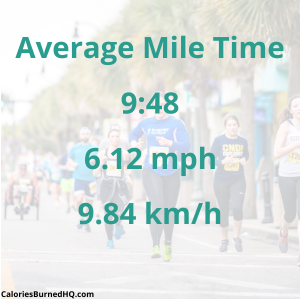
As the average human running speed can vary so much, we’ve based our speeds on the average 1 mile run time by age and ability for men, women, and kids. You can also look at the average 5K time by age for more on average running time.
Actual speeds may vary depending on the environment, terrain, and the individual’s fitness level and therefore the speeds in this article are an approximation.
[lasso ref=”amzn-garmin-010-02120-20-forerunner-245-music-gps-running-smartwatch-with-music-and-advanced-dynamics-black” id=”20311″ badge=”Our pick for track running speed” link_id=”20918″]
Running levels
All the average running speed by age tables in this article are also according to running level and experience.
- Beginner runners: Runners who are new to running. They have usually only been running for about a month and need to work on their form, endurance, and fitness.
- Novice runners: Have been running for about 6 months. They’re a bit faster than beginners but may still need to work on endurance for long distances.
- Intermediate runners: Have been running consistently for at least 2 years and have completed several races. An intermediate runner can keep a moderate pace over longer distances (such as a good average half-marathon time) without too much trouble.
- Advanced runners: Have been running consistently for at least 5 years and are very fit. Generally, they’re faster than 80% of other runners.
The average running speed for men is about 6.6 mph or 10.62 km/h. For women, the average human running speed is 5.7 mph or 9.17 km/h.
Summary
[lasso ref=”amzn-garmin-010-02120-20-forerunner-245-music-gps-running-smartwatch-with-music-and-advanced-dynamics-black” id=”20311″ badge=”Our pick for track running speed” link_id=”20919″]
Average running speed for women
In general female runners have an average running speed of 5.7 mph or 9.17 km/h.
However, it’s important to remember that individual performance can vary significantly. In addition, factors such as training, running level, genetics, and other factors can also influence an individual’s running speed.
Average running speed mph for women — beginners
A beginner or novice runner has been running consistently for a month to 6 months and will have a running speed of about 6 mph.
| Age | Beginner | Novice |
| 10 | 4.1 | 5.0 |
| 15 | 4.0 | 5.0 |
| 20 | 6.0 | 6.7 |
| 25 | 6.0 | 6.7 |
| 30 | 6.0 | 6.7 |
| 35 | 5.9 | 6.6 |
| 40 | 5.8 | 6.5 |
| 45 | 5.6 | 6.3 |
| 50 | 5.3 | 5.9 |
| 55 | 4.9 | 5.5 |
| 60 | 4.5 | 5.0 |
| 65 | 4.2 | 4.7 |
| 70 | 3.9 | 4.3 |
| 75 | 3.7 | 4.1 |
| 80 | 3.4 | 3.8 |
| 85 | 2.8 | 3.1 |
| 90 | 2.5 | 2.7 |
Average running speed mph for women — intermediate to advanced
Intermediate to advanced runners have at least 2 to 5 years of running experience. They will generally have faster speeds and greater intensity than beginner to novice runners and run at an average running speed of 6.7 to 8.6 mph.
| Age | Intermediate | Advanced |
| 10 | 5.9 | 6.8 |
| 15 | 5.6 | 6.4 |
| 20 | 7.8 | 8.8 |
| 25 | 7.8 | 8.8 |
| 30 | 7.8 | 8.8 |
| 35 | 7.7 | 8.7 |
| 40 | 7.6 | 8.6 |
| 45 | 7.4 | 8.4 |
| 50 | 7.1 | 8.1 |
| 55 | 6.7 | 7.5 |
| 60 | 6.2 | 6.9 |
| 65 | 5.8 | 6.4 |
| 70 | 5.3 | 5.8 |
| 75 | 5.0 | 5.5 |
| 80 | 4.7 | 5.2 |
| 85 | 3.8 | 4.2 |
| 90 | 3.5 | 3.8 |
Average running speed km/h for women — beginners
The average running speed km/h for women will vary but will be about 9.7 to 11.3 km/h.
| Age | Beginner | Novice |
| 10 | 6.6 | 8.0 |
| 15 | 6.4 | 7.7 |
| 20 | 9.7 | 10.8 |
| 25 | 9.7 | 10.8 |
| 30 | 9.7 | 10.8 |
| 35 | 9.5 | 10.6 |
| 40 | 9.3 | 10.5 |
| 45 | 9.0 | 10.2 |
| 50 | 8.5 | 9.5 |
| 55 | 7.9 | 8.9 |
| 60 | 7.2 | 8.0 |
| 65 | 6.8 | 7.6 |
| 70 | 6.3 | 6.9 |
| 75 | 6.0 | 6.6 |
| 80 | 5.5 | 6.1 |
| 85 | 4.5 | 5.0 |
| 90 | 4.0 | 4.4 |
Average running speed km/h for women — intermediate to advanced
Generally advanced to intermediate runners will have a faster and more efficient running speed than less experienced runners. They will average about 10.8 to 13.8 km/h.
| Age | Intermediate | Advanced |
| 10 | 9.5 | 10.9 |
| 15 | 9.0 | 10.3 |
| 20 | 12.6 | 14.2 |
| 25 | 12.6 | 14.2 |
| 30 | 12.6 | 14.2 |
| 35 | 12.4 | 14.0 |
| 40 | 12.2 | 13.8 |
| 45 | 12.0 | 13.6 |
| 50 | 11.5 | 13.0 |
| 55 | 10.8 | 12.1 |
| 60 | 10.0 | 11.1 |
| 65 | 9.3 | 10.3 |
| 70 | 8.6 | 9.3 |
| 75 | 8.0 | 8.8 |
| 80 | 7.6 | 8.4 |
| 85 | 6.1 | 6.8 |
| 90 | 5.6 | 6.1 |
In general, female runners have an average running speed of 5.7mph or 9.17km/h. Running speed will vary depending on your ability and age.
Summary
Average running speed for men
The average human running speed for male runners is about 6.6 mph (10.62 km/h). It also depends on several factors, including age, fitness or running level, and the distance being run. On average, men have a faster running speed compared to women.
It’s important to note that these figures represent general averages and that individual performance can vary significantly based on various factors such as training, experience, and genetic predisposition.
Average running speed mph for men — beginners
Most men who just start running can expect to run between 6 to 7 miles per hour.
| Age | Beginner | Novice |
| 10 | 4.32 | 5.19 |
| 15 | 4.25 | 5.13 |
| 20 | 6.37 | 7.71 |
| 25 | 6.37 | 7.71 |
| 30 | 6.35 | 7.68 |
| 35 | 6.29 | 7.56 |
| 40 | 6.03 | 7.30 |
| 45 | 5.85 | 7.10 |
| 50 | 5.61 | 6.91 |
| 55 | 5.38 | 6.68 |
| 60 | 5.16 | 6.46 |
| 65 | 4.95 | 6.00 |
| 70 | 4.74 | 5.69 |
| 75 | 4.38 | 5.31 |
| 80 | 3.96 | 4.98 |
| 85 | 3.72 | 4.62 |
| 90 | 3.49 | 4.36 |
Average running speed mph for men — intermediate to advanced
Intermediate to advanced runners will have fast running speeds compared to new runners. More experienced male runners will average 6.7 to 8.6 mph.
| Age | Intermediate | Advanced |
| 10 | 6.06 | 7.16 |
| 15 | 6.00 | 7.06 |
| 20 | 9.06 | 10.43 |
| 25 | 9.06 | 10.43 |
| 30 | 9.02 | 10.43 |
| 35 | 8.92 | 10.29 |
| 40 | 8.61 | 9.94 |
| 45 | 8.38 | 9.63 |
| 50 | 8.07 | 9.18 |
| 55 | 7.80 | 8.88 |
| 60 | 7.43 | 8.47 |
| 65 | 7.06 | 8.11 |
| 70 | 6.68 | 7.72 |
| 75 | 6.25 | 7.22 |
| 80 | 5.65 | 6.50 |
| 85 | 5.25 | 6.06 |
| 90 | 4.95 | 5.72 |
Average running speed km/h for men — beginners
Beginners will have an average running speed of 9.7 to 11.3 km/h.
| Age | Beginner | Novice |
| 10 | 6.96 | 8.36 |
| 15 | 6.84 | 8.27 |
| 20 | 10.26 | 12.43 |
| 25 | 10.26 | 12.43 |
| 30 | 10.22 | 12.37 |
| 35 | 10.12 | 12.17 |
| 40 | 9.71 | 11.76 |
| 45 | 9.40 | 11.42 |
| 50 | 9.03 | 11.11 |
| 55 | 8.66 | 10.76 |
| 60 | 8.31 | 10.40 |
| 65 | 7.97 | 9.66 |
| 70 | 7.63 | 9.16 |
| 75 | 7.04 | 8.54 |
| 80 | 6.38 | 8.02 |
| 85 | 5.99 | 7.44 |
| 90 | 5.62 | 7.02 |
Average running speed km/h for men — intermediate to advanced
Intermediate to advanced male runners will have an average speed of 10.8 to 13.8 km/h.
| Age | Intermediate | Advanced |
| 10 | 9.76 | 11.53 |
| 15 | 9.66 | 11.36 |
| 20 | 14.58 | 16.77 |
| 25 | 14.58 | 16.77 |
| 30 | 14.51 | 16.77 |
| 35 | 14.35 | 16.54 |
| 40 | 13.85 | 15.99 |
| 45 | 13.49 | 15.50 |
| 50 | 13.00 | 14.78 |
| 55 | 12.55 | 14.28 |
| 60 | 11.96 | 13.63 |
| 65 | 11.36 | 13.05 |
| 70 | 10.77 | 12.43 |
| 75 | 10.06 | 11.63 |
| 80 | 9.09 | 10.47 |
| 85 | 8.46 | 9.76 |
| 90 | 7.97 | 9.20 |
The average human running speed for male runners is about 6.6 mph (10.62 km/h).
Summary
What is the average human running speed by distance?
The average human running speed by distance will vary depending on the distance. This is mainly due to the different physiological and physical demands placed on the body for various distances.
The tables below cover the average running speed by distance for men and women. Keep in mind that averages will vary depending on age, ability and environment.
Average running speed by distance for men
The most frequent 10K finishing time for men is about 54:30 – 55:30. This is an average running speed of 10.91 km/h.
| Distance | Men’s pace (min/km) |
Average running speed km/h |
Men’s pace (min/mile) |
Average running speed mph |
|---|---|---|---|---|
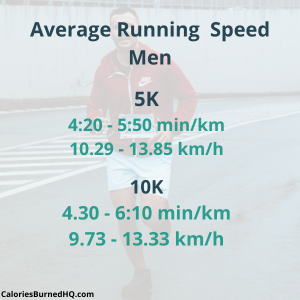
| 5K | 4:20 – 5:50 | 10.29 – 13.85 | 7:00 – 9:25 | 6.37 – 8.75 |
| 10K | 4:30 – 6:10 | 9.73 – 13.33 | 7:15 – 9:55 | 6.61 – 8.28 |
| Half Marathon (21.1K) | 5:00 – 6:50 | 8.78 – 12.00 | 8:05 – 11:00 | 5.45 – 7.42 |
| Marathon (42.2K) | 5:20 – 7:20 | 8.18 – 11.25 | 8:35-11:45 | 5.11 – 6.99 |
Calculate Running Speed With GPS
Average running speed by distance for women
The average finishing time for a 10K for women is about 58:30 – 59:30 minutes. This averages out to an average speed of 10.08 km/h.
| Distance | Women’s pace (min/km) |
Average running speed km/h |
Women’s pace (min/mile) |
Average running speed mph |
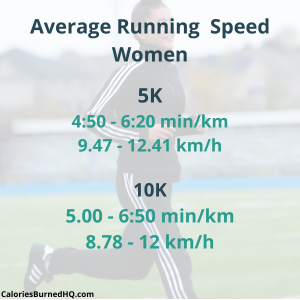
| 5K | 4:50 – 6:20 | 9.47 – 12.41 | 7:45-10:15 | 5.85 – 7.74 |
| 10K | 5:00 – 6:50 | 8.78 – 12 | 8:05 – 11:00 | 5.45 – 7.42 |
| Half Marathon (21.1K) | 5:30 – 7:20 | 8.18 – 10.91 | 8:50 -11:50 | 5.07 – 6.79 |
| Marathon (42.2K) | 5:50 – 8:00 | 7.50 – 10.29 | 9:20 – 12:55 | 4.65 – 6.43 |
The average running speed by distance will vary depending on the distance. Longer distances will have a slower running speed to cater for longer running time. In general, the average running speed for a 10K is about 10 km/h.
Summary
Average running pace vs running speed
Running speed and running pace are related to each other but are distinct concepts in the world of running. Knowing the difference between these two terms is vital for setting and achieving realistic goals and tracking your progress.
What is running speed?
Running speed refers to how fast you are running and is usually measured in units such as miles per hour (mph), kilometers per hour (km/h), or meters per second (m/s). It indicates the distance that you cover over a certain time. For example, you might run 10 kilometers in an hour.
What is running pace?
Running pace refers to the amount of time it takes you to cover a certain distance and is commonly measured in units such as minutes per mile (m/m) or minutes per kilometer (min/km). It’s a measure of the time it takes to run a specific distance.
Running pace provides a better indicator of your running performance because it also takes into account the distance you are running. For example, your pace will naturally be slower for longer races so that you can conserve your energy to cover the distance.
If you are planning to run longer distances, following a pace chart like this half marathon pace chart can help you stay on track to achieving your goal finish time.
Running speed is how fast you are running and is usually measured in km/h or mph. Running pace is the amount of time it takes you to cover a certain distance and is usually measured in min/km or min/mile.
Summary
[lasso ref=”amzn-garmin-010-02120-20-forerunner-245-music-gps-running-smartwatch-with-music-and-advanced-dynamics-black” id=”20311″ badge=”Our pick for track running speed” link_id=”20920″]
Factors that affect average running speed
There are several factors that can significantly influence your average running speed. Understanding each of these factors can help you improve your performance and achieve your running goals.
Here are a few factors to consider.
Fitness level and training
If you’ve seen an average person run versus an elite athlete, you can easily see that the fitter you are, the faster your running speed. Your level of physical fitness, muscle mass, and endurance will greatly influence how fast you can run.
Also, keep in mind that the type of training you do as well as how consistent you are will further influence your running speed.
Biomechanics and running form
Proper running form can help you run faster for longer with less pain. Studies show that proper running form is a key factor that influences running economy and performance. Factors such as stride length, cadence, foot strike, arm movement, and posture can influence running efficiency and ultimately affect overall speed.
Muscle strength and power
Building strong leg muscles, namely the quads, hamstrings, glutes, and calves is essential to help you generate the power for faster running speeds.
Studies have shown that including strength training in your training program to build muscle mass correlates with faster sprint speeds.
Endurance and cardiovascular health
The fitter you are, the more you can endure faster running speeds for longer durations without experiencing fatigue. Regular cardiovascular training such as interval training, sprints, hill training , and more can help improve your overall endurance and fitness.
Environmental factors
Weather conditions such as temperature, humidity, and wind speed can significantly affect your running speed. Heat and humidity levels can increase your fatigue and decrease your performance.
Other environmental factors such as altitude and air quality can also impact your oxygen levels which makes it harder to keep a fast running pace.
Terrain and surface
The type of surface or terrain can influence how fast you can run. Flat and smooth surfaces, such as tracks or paved roads, generally allow for faster speeds compared to uneven terrain or trails with obstacles.
Nutrition and hydration
To perform at your best, you need to make sure that you are fueling your body adequately with a balanced diet and staying hydrated, especially in hot, humid conditions.
Rest and recovery
Enough rest and recovery are essential to prevent overtraining and reduce the risk of injuries. Make sure you get adequate sleep, along with regular rest days and active recovery techniques, to allow the body to repair and strengthen your muscles. This will help improve your overall running speed and performance.
Factors that affect your average running speed include fitness level and training, biomechanics and running form, muscle strength, power, endurance, and cardiovascular health. Other factors include the environment and terrain, your nutrition and hydration, plus rest and recovery days.
Summary
How to improve your average running speed
Here are a few tips to improve your average running speed. If you are an athlete, it’s best to get some help from a personal trainer or follow a running program to improve your speed.
Don’t skip your warm up and cool down
Before you start running, it’s important to warm up your muscle properly so as to prepare them for exercise. This will also help prevent injuries and issues such as tight hip flexors or ankle pain from running. A warm-up might include walking, light jogging, mobility exercises and dynamic stretching.
After your run, take time to cool down properly by slowing down your pace, stretching and doing mobility exercises. Once again, cooling down can prevent injury and reduce stiffness.
Work on your running technique – top tips
You can run faster and more efficiently if you improve your running technique. This could mean working on your stride length and cadence, proper posture, and foot placement. A personal trainer or coach will give you guidance on improving your running technique.
Tips for better running form:
- Posture: Maintain a straight line from your head to your toes by keeping your head up, your shoulders back and relaxed, and your core engaged. This will make your movements more efficient and powerful.
- Foot strike: To reduce the impact of forces on your feet, land on the midfoot or forefoot, rather than the heel. This will also help improve your stride turnover – the number of steps you take per minute. The ideal stride turnover is 180 steps per minute as this creates a shorter stride length which makes you more efficient.
- Arm swing: Keep your arms relaxed and bent at 90-degree angles and swing them forward and back. This will help you keep your balance and rhythm.
- Breathing: Keep your shoulders relaxed and breathe from your diaphragm to get the most oxygen into your body.
https://www.youtube.com/watch?v=brFHyOtTwH4
Build muscle by weight training
Strength training will build muscle and increase running speed and endurance. Using a weighted vest for running has also been shown to increase running speed.
Exercises such as deadlifts, squats, and lunges will target the leg muscles used in running and sprinting. It’s important to include rest days and proper form to prevent injury.
https://www.youtube.com/watch?v=TjVp-uoTviA
Vary the type of training you do
Varying your running workouts can help you build strength, fitness and endurance. Include tempo runs, hill training, sprints, and drills into your training routine. If you’re aiming to run longer distances, include a longer training run to build endurance.
https://www.youtube.com/watch?v=sOJFx18dpa8
Eat a healthy balanced diet and stay well-hydrated
You need to provide your body with sufficient fuel for your run and to repair muscles and tissue post-run.
Make sure you are consuming sufficient complex carbohydrates, proteins, healthy fats, fruit and vegetables for a healthy balanced diet. Keep up your fluid levels to prevent dehydration and fatigue from setting in over long distances and races.
Set achievable goals
Set achievable goals to keep you motivated and focused on improving your running speed. Goals might be increasing your speed over a certain distance, running a certain distance or time, or participating in a race.
Break down larger goals into smaller, manageable steps to make them more attainable and build a sense of achievement.
The key to improving your average running speed is to work on proper running form and technique, vary your training, build muscle, and eat a balanced, healthy diet.
Summary
FAQs
What is the fastest running speed ever recorded?
The fastest recorded running speed is 44.72 km/h (27.8 mph). This was achieved by Usain Bolt during the 100m sprint at the 2009 World Championships in Berlin, Germany.
What is the fastest mile that anyone has ever run?
Hicham El Guerrouj of Morocco achieved the fastest recorded mile of 3:43.13 on the 7th of July 1999, in Rome, Italy.
What is the average running speed for a kid?
The average running speed for a kid will vary greatly depending on age and fitness level. In general, kids run between 4 – 7.5 mph (6-12 km/h).
What is the average running speed of a 15-year-old teenager?
The average running speed for a 15-year-old teenager will vary depending on the individual. Generally, a 15-year-old will have an average running speed of 5 – 7.5 mph (8 – 12 km/h).
Is 20 mph fast for a human?
Yes, 20mph is a very fast speed for a human, it’s approximately 32 km/h and is the speed of elite runners.
Is 15 mph fast for a human?
A running speed of 15mph (24 km/h) is a fast sprinting speed for a human.
Is 10mph fast running?
Running at a speed of 10 mph is a fast running speed usually achieved by advanced and elite athletes. It’s equivalent to running at 16km/h.
Is running 7 mph fast?
A running speed of 7 mph is considered a moderate to fast pace for a human. Novice to intermediate runners will be able to run at this pace. It’s equivalent to 11 km/h.
What is the average jogging speed?
Jogging is a slower pace than running. In general, the average jogging speed is between 4-6 miles per hour (6.4 to 9.7 km/h).
What is the average human sprint speed?
The average human sprint speed is about 18.23 mph which is 29.33 km/h.
Overall Summary
- The average running speed for men is about 6.6 mph or 10.62 km/h.
- The average running speed for women is about 5.7 mph or 9.17 km/h.
- For men, the average running speed for a 10K is 10.91 km/h. For women, it’s 10.08km/h.
Sources
- 2018 Year In Sport
- Performance Trends in large 10-km Road Running Races in the United States
- Running Technique is an Important Component of Running Economy and Performance
- Increases in lower-body strength transfer positively to sprint performance: a systematic review with meta-analysis