Want to know how to do more pull-ups?
Follow these guidelines for techniques how to use resistance bands to build up your strength gradually without the risk of injury. We also have a few other tips to help you reach your goals.
When you purchase through links on our site, we may earn an affiliate commission. Here’s how it works.
Table Contents
Why can I not do pull-ups?
The ability to perform pull-ups is a common fitness goal that takes dedication, proper technique, and practice. It also helps to address the particular factors that might prevent you from doing pull-ups.
Here are some of the top reasons why you can’t do a pull-up:
Lack of grip strength
A lack of grip strength or weak grip strength can be one of the main reasons why you’re struggling to do pull-ups.
To do a pull-up, your hands are required to hold onto the bar and keep your body stable throughout the movement.
If you have weak grip strength, you won’t be able to hold onto the bar properly, resulting in your hands slipping off the bar. Your hands will also fatigue faster than the strong muscles in your back causing your forearms to give out before you’ve finished the pull-up.
Here are a few tips to strengthen your grip strength:
- Practice hanging from the bar for increasing duration. For an extra challenge, include dead hangs with one arm.
- Farmer’s walk – a farmer’s walk involves carrying a heavy object in each hand and walking. For example, you can hold a heavy-weight plate in each hand and walk up and down your garage.
- Plate pinches – hold a heavy-weight plate between your thumb and fingers for as long as possible.
- Wringing a wet towel – wring out a wet towel as hard as you can for repetitions.
https://youtu.be/gn8Yxfn0iaE?si=_tdiy_rW4TGXrMXW
Weak back muscles, abs, and biceps
Strengthening the back muscles, abs, and biceps will help you perform a pull-up.
One of the reasons why using resistance bands is a good option is that it also allows you to gradually strengthen your back, abs, and biceps while progressing with pull-ups.
You’re not used to lifting your body weight
Your body needs to get used to lifting its weight. If you’ve only trained with weight machines or light weights, you won’t be used to lifting your body weight. Include bodyweight exercises into your workout routine to help with this.
You’re overweight
A pull-up requires you to pull yourself up above a bar. If you are overweight, this can be extremely challenging.
Focus on losing weight and you’ll also find it easier to perform a pull-up the lighter you become. For a workout routine that can help you lose weight, read Free Workouts for Men Over 40.
Previous injuries or health conditions
If you’ve injured your elbows, shoulders, or other areas, pull-ups might be challenging. Check in with your healthcare professional or physical therapist before performing pull-ups just to make sure that you’re not aggravating a previous injury.
There are several reasons why you can’t do a pull-up yet. Work on your grip strength, and upper body strength, and get used to lifting your body weight. Lastly, losing those extra pounds will make it easier!
Summary
Use resistance bands to assist you
Resistance bands can help you complete a full pull-up with assistance. They allow you to gradually work on strengthening the muscles by carrying some of the load for you.
Studies have shown that the muscles activated and worked in assisted pull-ups are the same as those used in unassisted pull-ups.
[lasso ref=”amzn-thinefit-pull-up-assistance-bands-resistance-band-pull-up-bands-workout-band-resistance-band-set-of-6-with-door-anchor-exercise-band-for-working-out-muscle-training-physical-therapy-shape-body” id=”23477″ link_id=”24222″]
How to use resistance bands in a pull-up
- Secure the band over the pull-up bar and put your knee through the loop on the other end.
- Place your hands overhand, shoulder-width grip apart, and hang with your arms fully extended.
- Grip the pullup bar tightly, squeeze your shoulder blades, and pull yourself up.
- Aim to reach the bar with your chest.
- Lower yourself down slowly until your arms are fully extended.
For more tips plus a few pull-up variations, read Assisted Pull-Ups with Resistance Bands.
https://youtube.com/watch?v=_JSKauLJ5No?si=XxGt_O6cqmaONAwq
How to progress using resistance bands for pull-ups
As resistance bands aren’t standardized, it’s difficult to give exact guidelines as to what band to use and when. However, here’s a general guide to help you use resistance bands for pull-ups.
1. Choose a band or a combination of bands that will give you the least amount of assistance to perform 3 sets of 5 pull-ups.
2. Train 2 to 3 times a week with a minimum of 1 day rest between.
3. Increase by 1 rep each week.
4. Once you can do 8 pull-ups, reduce the assistance from the bands until you can only do 5 reps.
5. Go back to start and do 3 sets of 5 pull-ups, slowly building up by a rep each week.
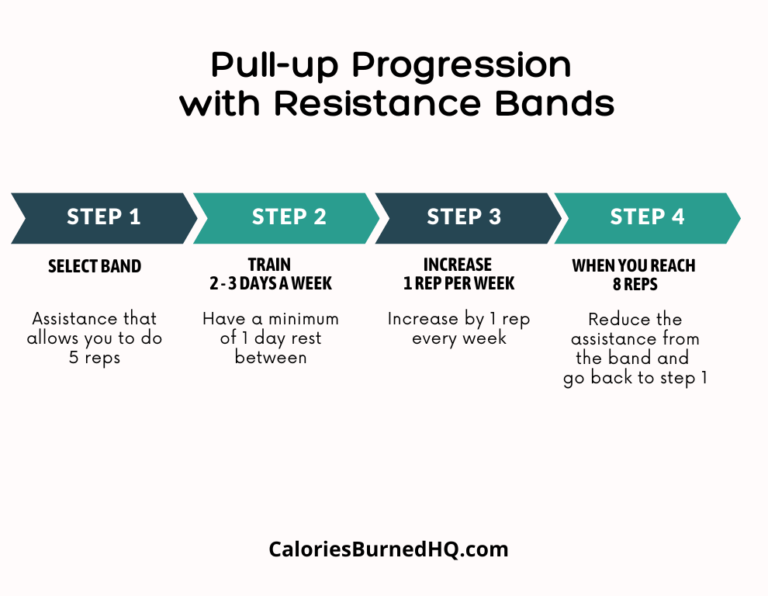
Use resistance bands to help you perform a full pull-up. Gradually build up strength until you can easily perform 8 reps, then reduce the assistance to challenge yourself again.
Summary
Focus on technique
The pull-up is a classic and effective upper-body exercise. It targets multiple muscle groups, including the upper back and lower back muscles (latissimus dorsi or lats, rhomboids, posterior deltoids, and biceps.
It’s also very challenging. Most people, especially those who have not exercised before, won’t have the upper body strength to smash out full reps and multiple sets of actual pull-ups.
However, it’s quite possible to build up your strength and skill to do more bodyweight pull-ups. The first place to start is to use your mind to specifically focus on working the muscles of your back and learning the technique.
According to the American Council for Exercise, the mind-muscle connection is the act of consciously and deliberately thinking about moving a specific target muscle. In fact, according to research, just thinking about a muscle can strengthen a muscle without exercising it.
A strong mind-muscle connection is important for engaging the correct muscles in a pull-up. If you can’t feel your muscles, don’t worry, as you persevere with pull-ups you’ll soon become aware of the muscles being worked.
Here’s how you can improve your mind-muscle connection.
1. Focus and intention
Focus your attention on the specific muscles you want to activate during your pull-up. For example, you might want to focus on your grip strength or activating your scapulae.
2. Control your movements
Perform the pull-up with intention and control. Avoid jerky, sudden movements and focus on deliberate controlled movements.
3. Feel the muscles work
This can take a bit of practice but as you persevere, you’ll be able to feel the muscles working.
Learn proper pull-up form
The key to doing your first pull-up is to learn proper technique and form. A classic pull-up has an overhand grip with your hands slightly wider than shoulder-width apart.
The starting position for a pull-up is to hang from the bar with the arms fully extended. Squeeze your shoulder blades together and pull your chest towards the bar.
Lower yourself back down with control until your arms are fully extended.
https://youtube.com/watch?v=ZPG8OsHKXLw?si=g-LR61uNN4cvCyob
Learn proper pull-up technique and form as a foundation to performing more pullups.
Summary
Practice dead hangs
As the name implies, a dead hang is a fundamental exercise that builds grip strength, improves shoulder stability, and improves your overall endurance for pull-ups.
How to perform a dead hang
- Grab the pull-up bar in an overhand grip and your hands shoulder-width apart.
- Hang from the bar with your arms fully extended.
- Relax your shoulders and grip the pullup bar tightly.
- Gradually increase the duration of the hang as your strength improves.
https://youtube.com/watch?v=KtJ-ELaFmL8?si=YYtGmI8xBm3mINvb
Add dead hangs with scapular pull-ups
Combine the dead hang with a few scapular pull-ups that target the muscles responsible for starting the pull-up motion. It helps to activate and strengthen the muscles needed for the initial phase of a pull-up.
https://www.youtube.com/watch?v=FgYoc4O-cio&t=81s
Dead hangs will build grip strength and endurance. Add scapular pull-ups to target the muscles responsible for the pull-up motion.
Summary
Include negative pull-ups
Negative pull-ups (or negatives) focus on the lowering (eccentric) phase of the pull-up and help build strength during the lowering motion.
- Stand on a box or chair to start at the top of the pull-up position (chin over the bar).
- Lower yourself down slowly, for at least 3-5 seconds.
- Repeat for multiple reps.
https://youtu.be/EkpJkHpJXmM?si=Bhew_fUKCURbQOYR
Add jumping pull-ups
Jumping pull-ups can help you practice the full pull-up motion with the assistance of a jump.
- Stand beneath the pull-up bar.
- Jump up and use the momentum to help pull your chin over the bar.
- Lower yourself down with control.
https://youtu.be/eRRmHSwl4EI?si=IDPPN3GNePaBJZ1l
Try a few unassisted pull-ups
Trying a few unassisted pull-ups can help your body adapt and build strength. Once you’ve grown stronger, add in a few unassisted pull-ups or mix it up with one of these 12 types of pull-ups.
Negative pull-ups, jumping pull-ups, and a few unassisted pull-ups will allow your body to get used to moving your bodyweight.
Summary
Exercises that will help you do pull-ups?
While nothing beats doing pull-ups when you want to learn how to do more pull-ups, you can strengthen the back muscles, abs, and biceps by performing other exercises as well.
Lat pulldowns with resistance bands
https://youtu.be/eItdYA8i5ec?si=UMEO3ByY-EGazQ5_
- To do lat pull downs with resistance bands, secure the band around your pull-up bar.
- Grip the bands in line with your shoulders and kneel so that your arms are extended above your head.
- Pull the bands down as if you’re doing a pull-up.
Ring rows
https://youtu.be/xhlReCpAE9k?si=aCYjIBln1BFZYycr
- Hang the rings about shoulder-width apart on the pull-up bar.
- Set the ring height so that it’s even and about hip height.
- Walk the legs so that you’re lying underneath the rings. Start with the arms and legs extended.
- Pull the elbows down until the rings touch the side of your chest.
Scapular retraction
https://youtu.be/3AZ_iF-_RFE?si=jNJf5LIzvhHs4dpA
Scapular retraction involves squeezing the shoulder blades together. Squeezing your scapula together is the starting point of a pull-up.
- Stand or sit with good posture.
- Squeeze your shoulder blades together
- Hold for a moment, then release.
This exercise activates the muscles around your scapulae, which is crucial for pull-ups.
Hollow body hold
https://youtu.be/LlDNef_Ztsc?si=EQg9cTA3b2qx66Sq
- Lie on your back. Lift your legs and upper body off the ground.
- Engage your core to keep your body in a straight line
- Hold the position for as long as possible.
This exercise will strengthen your core and torso which can improve stability during pull-ups.
There are several exercises that you can use to strengthen your back, torso, and arms to help you perform a pull-up. Remember to progress gradually to prevent injury.
Summary
FAQs
How many pull-ups should I be able to do?
As a general guideline, men should be able to do at least 8 pull-ups and women 3. However, this can vary between individuals.
How can I improve my grip strength for pull-ups?
You can improve your grip strength by doing dead hangs, carrying heavy weights in your hands, and hanging leg raises.
What are some good assisted pull-up exercises?
Using resistance bands is one of the best assisted pull-up exercises. You can also do negative pull-ups and jumping pull-ups.
How often should I train pull-ups?
We recommend training pull-ups 2-3 times a week with a minimum of 1 day rest between.
Do pull-ups get easier over time?
Yes, they do. As you grow in strength, improve in technique, and lose weight, pull-ups will become easier.
Overall Summary
- If you want to know how to do more pull-ups, a good place to start is to use resistance bands to help you perform assisted pullups.
- Once you can perform 8 reps, reduce the assistance until you can perform 5 pull-ups and build up your strength.
- As you grow stronger, lose weight, and improve your technique, you’ll find it easier to perform a pull-up.
Sources
- Electromyographical Comparison of a Traditional, Suspension Device, and Towel Pull-Up
- The Mind-muscle Connection
- The power of the mind: the cortex as a critical determinant of muscle strength/weakness
- Electromyographical Comparison of a Traditional, Suspension Device, and Towel Pull-Up