Lift your pull-up game with these 12 types of pull-ups progressing from beginner level to advanced.
We cover the type of pull-up, why it can help you grow stronger plus the muscles it works. We’ve also got videos for each variation so that you can see how to perform the specific pull-up.
When you purchase through links on our site, we may earn an affiliate commission. Here’s how it works.
Table Contents
1. Resistance band pull-ups – beginner
Resistance band pull-ups use elastic bands to reduce the amount of body weight that you need to lift during a pull-up. This makes it easier to focus on form and gradually build your strength.
Remember, strength not only applies to your muscles but also your tendons and ligaments which tend to take longer to strengthen. [1] Gradually increasing the load will help strengthen your tendons and ligaments which will help to prevent injury.
We recommend the THINEFIT Pull-Up Assistance Bands because they have a bundle of resistance bands that are color-coded to help you work out the best band to assist you.
[lasso ref=”amzn-thinefit-pull-up-assistance-bands-resistance-band-pull-up-bands-workout-band-resistance-band-set-of-6-with-door-anchor-exercise-band-for-working-out-muscle-training-physical-therapy-shape-body” id=”23477″ link_id=”26205″]
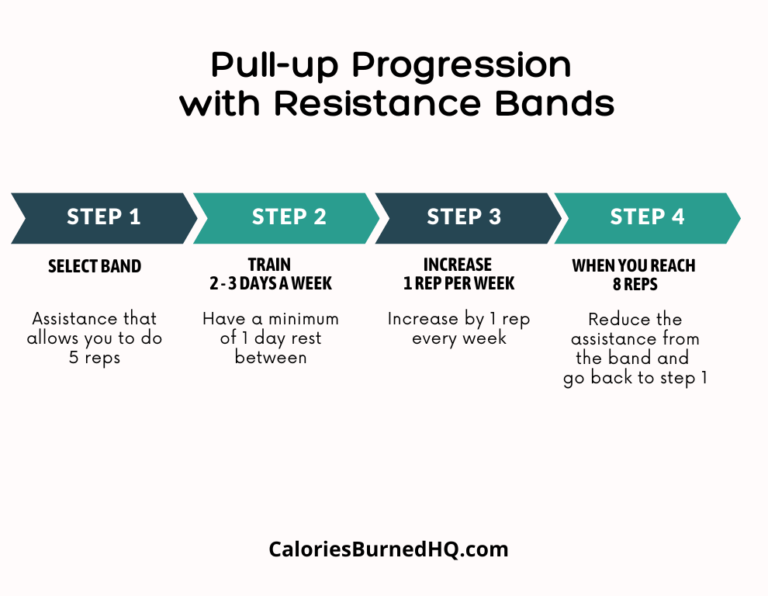
To do assisted pull-ups with resistance bands, choose the band that allows you to do 5 pull-ups. Gradually increase by a rep each week until you can do 8.
Reduce the assistance from the band so that you can only perform 5 pull-ups. Once more, increase by a rep each week until you can perform 8 pull-ups.
Muscles worked by resistance band pull-ups
How to do a resistance band pull-up
https://www.youtube.com/watch?v=Dx6DNiOklZI
- Attach the resistance band to a pull-up bar.
- Place one knee into the loop of the band.
- Grip the bar with your hands shoulder-width apart.
- Hang from the bar and then pull yourself up, using the assistance provided by the band.
- Lower yourself back down with control.
Assisted pull-ups with resistance bands are a great option for beginners. The assistance from the bands helps you to focus on perfecting your form while gradually growing stronger.
Summary
2. Incline pull-ups or ring rows – beginner
An incline pull-up sets the bar lower than a standard pull-up bar (about hip height). The person holds onto the bar and walks their feet forward until the body is at an incline and then pulls themselves up towards the bar in a rowing movement.
The lower bar placement reduces the resistance required to pull yourself up and allows you to gradually grow stronger.
For a greater challenge, you can also perform ring rows. Instead of lowering the bar, use hanging rings to perform the rows. We recommend the rings below as the straps have markings to help you hang them evenly.
[lasso ref=”amzn-pacearth-gymnastics-rings-wooden-olympic-rings-1500-1000lbs-with-adjustable-cam-buckle-14-76ft-long-straps-with-scale-non-slip-gym-rings-for-home-gym-full-body-workout” id=”23475″ link_id=”26206″]
Muscles worked by incline pull-ups or ring rows
- Lats
- Rear deltoids [5]
- Biceps
- Rhomboids
How to do an incline pull-up
https://www.youtube.com/watch?v=AlDXMqD6RKA
- Hold onto the bar and walk your feet forward until your body is inclined.
- Pull yourself up towards the bar so that your chest touches the bar.
- Lower yourself back down.
How to do an incline ring row
https://www.youtube.com/watch?v=B90sF7dbP04
- Hang the rings at about hip height from the pull-up bar. Grab the rings with both hands.
- Walk your feet forward to form a 45-degree angle to the ground.
- Extend your arms and lock out your elbows.
- Squeeze your shoulder blades together, keep your elbows at your sides, and pull your hands towards your armpits until the rings touch your chest.
- Slowly lower yourself back down until your arms are locked out.
Ring rows work the muscles required to perform pull-ups by reducing the resistance so that you don’t have to pull up your whole body weight.
Summary
3. Negative pull-ups – beginner
A negative pull-up focuses on the lowering phase of the pull-up. Instead of pulling yourself up to the bar, you start at the top and lower yourself down slowly. This helps to build strength, grip strength, forearm strength, and control and targets the muscles required to do a pull-up.
According to a Men’s Health article on eccentric training, performing negative pull-ups (eccentric pull-ups) is useful for building the strength to perform a full pull-up. [6]
Muscle groups worked by negative pull-ups
- Lats
- Rhomboids
- Biceps
- Forearms [7]
How to do a negative pull-up
https://www.youtube.com/watch?v=uDAFeKldDlM
- Use a sturdy chair or box to get into the top position of a pull-up.
- Slowly lower yourself down, taking at least 3-5 seconds.
- Repeat for multiple repetitions.
Negative pull-ups focus on the lowering phase of the pull-up. They are a great way to get used to the weight of your body.
Summary
4. Jumping pull-ups – beginner
Jumping pull-ups use the power in your lower body to jump up to the pullup bar to help in the upward phase of the pull-up. This helps beginners experience the full range of motion of the pull-up without having to lift their full body weight.
Jumping pull-ups help to develop the explosive strength required for the initial pull in a regular pull-up. This can be particularly helpful for beginners working on building the strength required for the exercise.
Muscle groups worked by jumping pull-ups
- Latissimus dorsi
- Biceps
- Upper back muscles
How to do a jumping pull-up
https://www.youtube.com/watch?v=eRRmHSwl4EI
- Stand below the pull-up bar.
- Jump and use the momentum to pull your chin above the bar.
- Lower yourself back down in a controlled manner.
As you master the first 4 pull-ups for beginners, continue to challenge yourself with different types of pull-ups that are more advanced. Not only will this help you grow stronger, but it can also keep you motivated as you learn how to do more pull-ups.
Jumping pull-ups use the explosive power of your legs to help you with the upward pull phase of the pull-up. Make sure you keep the movement controlled to prevent injury.
Summary
5. Weighted pull-ups – intermediate
Steadily progressing and challenging yourself is one of the key principles that can help you grow stronger and lose weight. For more on this, check out these free workouts for men over 40.
If you can perform 6-8 standard pull-ups without assistance, then adding weight to your pull-ups will increase muscle activation and the intensity of your workout, plus help you build strength.
The added weight will stimulate your muscles to work harder to complete a full pull-up. When you remove the weights and perform a standard pull-up, you’ll feel much lighter and stronger.
Muscles worked by weighted pull-ups
- Latissimus dorsi
- Biceps
- Trapezius
How to do weighted pull-ups
https://www.youtube.com/watch?v=KOw6VhY8McQ
- You’ll need a weighted vest, weight belt, or dip belt with weight plates attached. Some people also hold a dumbbell between their feet.
- Choose a weight that will allow you to perform 4 reps.
- Position your hands shoulder-width apart.
- Initiate the pull-up by squeezing your shoulder blades together and pulling your elbows down and toward the sides.
- Pull yourself up until your chest reaches the bar, keep your core engaged, and maintain proper form.
- Control the movement as you lower yourself down until your arms are fully extended. Avoid swinging on the way up or down.
Adding extra weight in a pull-up will challenge your muscles, grow your back, and help you to grow stronger. Start light and gradually progress.
Summary
6. Close-grip pull-ups – intermediate
Close-grip pull-ups use a narrower grip that’s closer than shoulder-width apart. This type of pull-up places more emphasis on the biceps and the muscles of the inner back and targets these areas.
By strengthening these muscles, you increase your overall pulling power which improves performance in standard pull-ups.
Muscles worked by close-grip pull-ups
- Biceps
- Inner back (teres major and minor)
- Rhomboids
- Lats
How to do a close-grip pull-up
https://www.youtube.com/watch?v=VuIkwZEEdEQ
- Position your hands closer together than shoulder-width and grip the bar.
- Hang from the bar with your arms fully extended.
- Pull yourself up, bringing your chin over the bar.
- Lower yourself back down with control.
Close-grip pull-ups use a grip that is narrow and closer together compared to your shoulder width. It places a greater challenge on your arms and inner back.
Summary
7. L-sit pull-ups – intermediate
L-sit pull-ups use the traditional pull-up motion while keeping your body in an L-sit position. This type of pull-up engages your abs and core muscles and places an additional challenge on your upper body strength. It’s a great exercise to include in your workout.
By increasing your core strength and stability, as well as your upper body strength, you’ll improve your overall body control and coordination.
Muscles worked by L-sit pull-ups
- Core muscles (rectus abdominis, obliques)
- Latissimus dorsi
- Biceps
How to do an L-sit pull-up
https://www.youtube.com/watch?v=CDKQ3MgWohw
- Place your hands shoulder-width apart.
- Hang from the bar and lift your legs in an L-sit position.
- Pull yourself up, maintaining the L-sit.
- Lower yourself back down with control.
The L-sit pull-up requires strong abs, lats, and quads. It’s a challenging pull-up but will give you great results.
Summary
8. Commando pull-ups – intermediate
Commando pull-ups require a close-supinated grip with the hands facing each other. The pull-up movement is slightly to the side as you pull yourself up to avoid your head from hitting the bar. This places an additional challenge on your grip strength, core, and lats.
Muscle groups worked by commando pull-ups
- Brachialis
- Brachioradialis
- Latissimus dorsi
- Biceps
How to do commando pull-ups
https://www.youtube.com/watch?v=GITBFhecTII
- Stand sideways underneath the pull-up bar.
- Grip the pull-up bar with one hand in front of the other.
- Pull yourself up towards one hand – the pull-up movement will be slightly to the side to avoid hitting your head.
- Lower yourself down and repeat on the other side. Be careful not to strain your neck.
Commando pull-ups will challenge your core and grip strength. Make sure you repeat the movement on both sides to work your sides evenly.
Summary
9. Wide-grip pull-ups – advanced
Wide-grip pull-ups use a grip that is slightly wider than shoulder-width apart. This type of pull-up targets the outer back muscles and challenges the shoulders. A very wide grip puts you at risk of injuring your shoulders, so make sure that your grip is only just wider than shoulder-width.
The wider grip increases the distance your body must travel and places a greater load on the outer lats and deltoids. This pull-up variation also requires additional shoulder stability and strength.
Muscles worked by wide-grip pull-ups
- Latissimus dorsi (outer)
- Deltoids (outer)
- Rhomboids
- Biceps
How to do wide-grip pull-ups
https://www.youtube.com/watch?v=7IV729pBFUc
- Grip the pull-up bar with hands slightly wider than shoulder-width apart.
- Hang from the bar with your arms fully extended.
- Pull yourself up, bringing your chest towards the bar.
- Lower yourself back down with control.
Position your hands slightly wider than shoulder-width apart to perform a wide-grip pull-up. Make sure that they are not too far apart as this places unnecessary strain on the shoulders.
Summary
10. Archer pull-ups – advanced
Archer pull-ups are called “Archer” because they look like an archer pulling back a bowstring. One arm stays straight while the other performs a pulling motion.
This pull-up variation challenges the chest and triceps on one side while working the lats and biceps on the other. They require a significant amount of strength and stability on both sides of the body. The straight arm also adds isometric work for the pushing arm which makes it more challenging than standard pull-ups.
Muscles worked by archer pull-ups
- Lats
- Biceps
- Chest (on one side)
- Triceps (on one side)
How to do archer pull-ups
https://www.youtube.com/watch?v=NuqcoOAsTMA
- Start with a wide grip on the pull-up bar.
- Shift your body to one side while keeping one arm straight and the other bent.
- Pull up with the bent arm, bringing your chest towards that side of the bar.
- Lower yourself back down and repeat on the other side.
An archer pull-up is not for the fainthearted. It’s an advanced pull-up that will challenge your upper body and core. Make sure that you repeat the movement on both sides.
Summary
11. One-arm pull-ups – advanced
One of the most difficult pull-up variations, one-arm pull-ups involves using one arm to pull up your entire body weight while the other arm remains inactive. A one-arm pull-up requires exceptional upper-body strength and lots of practice.
Muscles worked by one-arm pull-ups
- Lats
- Biceps
- Forearms
- Core muscles
How to do one-arm pull-ups
https://www.youtube.com/watch?v=mTJHClMQPM8
- Place your hands shoulder-width apart on the pull-up bar.
- Shift your body to one side, engaging the working arm.
- Pull yourself up with the working arm, keeping the other arm inactive.
- Lower yourself back down with control.
Another advanced pull-up, one-arm pull-ups use one arm to pull you up while the other remains inactive. Be careful of injuring your joints and muscles by progressing too quickly.
Summary
12. Muscle-ups – advanced
Another very demanding pull-up variation, muscle-ups are a combination of a pull-up and a dip. You transition from hanging below the bar to pushing yourself up above it in one movement.
Muscle-ups are challenging due to the explosive power needed to transition from the pull-up phase to the dip phase. This exercise demands advanced upper body strength, coordination, and timing.
Muscles worked by muscle-ups
- Lats
- Biceps
- Triceps
- Chest
- Shoulders
How to do muscle ups
https://www.youtube.com/watch?v=Gpny7WAAZ44
- Start with a false grip (thumbs above the bar or an overhand grip) on the pull-up bar. Your hands should be shoulder-width apart.
- Pull yourself up.
- Once your chest is higher than the bar, lean forward and change into a dip by pushing yourself above the bar.
- Lower yourself back down in a controlled manner.
A muscle up is a combination of a pull-up and a dip. Although it requires upper body strength, it’s also technique.
Summary
FAQs
What’s the best pull-up type for beginners?
Resistance band pull-ups are the best type of pull-ups for beginners. It helps you to learn and perfect your pull-up form and technique while building strength to perform a proper unassisted pull-up.
How many pull-ups should I be able to do?
There’s no specific number of pull-ups that you should be able to do. When starting pull-ups, aim for 5-8 reps before progressing.
Can I do pull-ups without a bar?
Yes, you can. You can improvise by using a towel wrapped around a door (towel pull-ups), a door pull-up bar, tree branches, playground equipment, and more. For best results, invest in a wall-mounted pull-up bar to prevent the risk of injury.
What type of pull-up is the hardest?
One-arm pull-ups are the most challenging, followed by archer pull-ups and muscle ups.
Are there any modifications for pull-ups if I have limitations?
Yes, you can use resistance bands to assist you, focus on negative reps (lowering yourself in a controlled manner), jumping pull-ups, and ring rows.
Overall Summary
- There are plenty of variations to help you learn how to do a proper pull-up.
- Using resistance bands is one of the best ways to assist you if you are a beginner.
- Once you can perform a few unassisted pull-ups, challenge yourself with a few intermediate to advanced types of pull-ups.